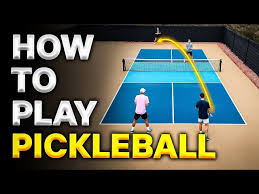
Pickleball is one of the fastest-growing sports in the world right now. It is very addictive, and once you start playing the game, there is no going back. This game was invented back in 1965 in Washington, USA. A group of three friends named Joel Pritchard, Bill Bell, and Barney McCallum were looking for a game that their kids would play together, so they combined badminton nets, table tennis bats, and wiffle ball and created the first iteration of Pickleball.
To know more about the game, we will have to understand some basic rules of how to play Pickleball, let's dive into the topic.
Pickleball Basic Rules
- Like every other racquet sport, Pickleball is played either as doubles (two players per team) or singles; doubles is most commonly played.
- For Pickleball the same size and area are used to play in both singles and doubles.
Pickleball Serve
- The player serving should move his hand upwards when the ball is struck.
- The contact of the pickleball paddle and the ball must not be made above waist level.
- The head of the paddle must not be above the highest part of the wrist during the POC.
- A ‘drop serve’ is allowed in the game, which means that the previous rules will not apply.
- While serving, the feet of the server should not extend beyond the imaginary lines of the sidelines or Additionally, one foot must be placed behind the baseline, on the court or either on the ground behind it.
- The serve should be directed diagonally and must land in the designated area of the opposite diagonal court just like any other racquet sport rule.
- Only one attempt at serving is allowed for each server.
Serving Sequence (Doubles)
- In a doubles game, both the players on the serving team can serve until they make a fault, except during the first service sequence of eachgame.
- The first serve of each side is taken from the right/even court.
- If a point is scored then the server will change the side and will serve from left/odd court.
- This is continued as long as points are scored, and until a fault occurs, at which point the first server loses their turn.
- When the first server loses the serve their partner will serve from the designated side of the court.
- The second server will keep on serving until their team commits a fault, which will result in losing the serve to the opposite team.
- When the serve goes to the opposite team, then the first serve will be from the right/even court, and both the players of a team will have a chance to serve and score until they commit two faults.
*In singles, the server serves from the right/even court when their score is even and from the left/odd when their score is odd.
*At the start of each new game, only one player from the serving team gets the chance to serve before a fault occurs, after which it goes to the receiving team.
Pickleball Scoring
- Points are only scored by the serving team.
- Games are played to 11 points, with a requirement to win by 2.
- In tournaments, games can be played with 15-21 points, also the requirement here is to win by 2.
- When the serving team’s score is even (0,2,4,6,8,10), the player who served first for the team will be positioned from the right/even court while serving/receiving.
- Similarly, if the serving team’s score is odd (1,3,5,7,9) that player will serve/receive from the left/odd side of the court.
Two-Bounce Rule in Pickleball
- Upon serving, the receiving team must allow the pickleball ball to bounce before returning it, then the serving team must let it bounce before making the return, resulting in two bounces.
- Once the ball bounces once on each team’s side, both teams are allowed to either volley the ball or play it after it has bounced.
- This rule removes the advantage of serving and volleying, which leads to longer rallies.
Line calls
When a pickleball touches any part of the line, except for the non-volley zone line during a serve, it is considered as “in”.
However, if a serve hits the non-volley zone line, it is considered short and will result in a fault.
Non-Volley Zone
- The non-volley zone is the area of the court that extends 7 feet on either side of the net.
- Players cannot volley with this zone, which prevents them from making a smash from that position.
- It is considered as a fault when a player steps or touches the non-volley zone while volleying, including the line or when the player's momentum causes them or anything they are wearing or carrying to touch the non-volley zone or its lines.
- Additionally, it is considered as a fault if a player after volleying, has carried the momentum and touches the non-volley zone, even if the volleyed ball is ruled dead before this occurs.
- Players can be in the non-volley zone at any time, except when they are volleying a This area is often referred to as ‘the kitchen”.